Sunday, June 26, 2016

The Social Network: The Man Who Sold the World


Since the advent of Facebook.com, the term “friend” has experienced an over-saturation not unlike what the word “love” has experienced since the 1960s.  It's nothing new to muse that this social media website connects us while at the same time denying us true intimacy, but a question might be raised about our intent: are we lost souls reaching out to one another through the cyber-sphere, longing for a meaningful connection we can never quite grasp?  Or are we hungry little capitalists in a masturbatory rat race, competing for popularity as a currency now easily quantifiable in little blue numbers?

This existential quandary is applied to one figure in The Social Network: a fictionalized version of the creator of Faceook himself, Mark Zuckerberg, as depicted by Jesse Eisenberg, written by Aaron Sorkinberg and expertly directed by none other than David Fincherberg.  The narrative of this Zuckerberg's life is, perhaps in parallel with the story of Facebook itself, one of a journey from failed search for real human connection to a successful accumulation of fortune and fame.  There are a couple of ways in which to trace this gradual transformation of Zuckerberg, through the film's relentless use of parallels.

First, there are the bookends of the movie, exemplified by the two most significant female characters – both of whom serve to function less as actual characters, and more as a mouthpiece for Zuckerberg's insecurities (Sorkin wisely toned down his attempts to write actual female characters in this script, perhaps on some level recognizing his greatest weakness as a writer).  At the beginning, Rooney Mara's fictional Erica Albright gets fed up with Zuckerberg's neurotic obsession with impressing the pretentious members of prestigious and exclusive “final clubs”.  Erica attends BU while Zuckerberg attends Harvard, and the gradual creep of Zuckerberg's sense of superiority, taking for granted that he is simply “better” than Erica, is what undoes the relationship.

So Erica utters the line that laid waste to all the social-conditioning groundwork of the John Hughes film era: Zuckerberg is not unsuccessful with women because he's a nerd, but because he's an asshole.  Now single and angry, and being the nerd and not an asshole that he is, Zuckerberg returns to his dorm, drunk-blogs about Erica's small breasts, and sets up a then-novel website in which images of the sorority girls of Harvard can be ranked against each other in terms of attractiveness by the male students.  It's an absurd overnight success, naturally – it's not hard to see why David “people are perverts” Fincher would gravitate towards this screenplay – and with it, Zuckerberg lays the foundation for his eventual internet empire.  One website, two lawsuits and billions of dollars later, Rashida Jones' lawyer character turns him down for a date, even though he is so rich and famous, and subverts Erica Albright's line from the beginning: Zuckerberg is not really an asshole, he's just trying to be one.  In a sense, both thesis and conclusion are true.  It's a matter of perspective.

This brings us to another parallel in the film, probably the most central one, in the form of Eduardo Saverin and Sean Parker, the respective angel and devil on Zuckerberg's shoulders.  At the beginning of the film we only get the contrast between Zuckerberg and Eduardo – the former being almost robotically single-minded in his ambition while the latter supports him eagerly out of friendship.  The red flags are present right from the beginning.  Eduardo talks to Zuckerberg like a good friend, while Zuckerberg's treatment of Eduardo consists mostly of gaslighting him with regards to his intelligence and general value as a person, then asking him for startup money.  It's almost impossible not to anticipate Zuckerberg eventually discarding Eduardo like an empty bottle of Mountain Dew after a long night of coding.

The way in which this betrayal manifests, though, is undeniably cruel.  Zuckerberg abandons Eduardo not for a more serious financier, and not even because of his own self-obsessed mentality.  He ditches Eduardo for Sean Parker, the broke, drug-addled founder of Napster, purely because of Sean's pseudo-celebrity.  Eduardo is the neglected nice-guy nerd Zuckerberg thought he was, and he trades him out for the asshole he's trying to be.

Mark's hunger for success is apparent, right from the beginning.  He harbors a deep, angry desire to prove himself to people, not for their approval, but for their envy.  It flares up after his rejection by Erica, and ultimately leads him to become the world's youngest billionaire.  But the source of his downfall, if an intangible one, is that as much as he wants to pursue the concept of success, he has no idea what it truly looks like.  It's easy to see success in terms of numbers, but how should it feel and behave?  When Zuckerberg meets Sean Parker, he thinks he's seen it.  A website-founding rock star who parties and fucks all the time.

Here contrast Zuckerberg with the Winklevoss twins, whose plan for a Harvard-exclusive social media website is swept from under them and turned into Facebook, certainly more than they could have hoped to accomplish.  Where Zuckerberg is constantly grasping for a model off of which to base his image of success, the Winklevi were evidently born with one, passed down from their father and probably many generations before.  They were on a streamlined track to a very specific definition of what success means, and Zuckerberg delights in tearing down that framework.

Zuckerberg, of course, is horribly wrong when it comes to his own personal aspirations.  Sean Parker was no precedent to him.  As portrayed in the film he's a paranoid, coked-out douchebag who finds fleeting success purely based on maintaining a framed persona and can't hold onto his money.  He is nothing but the image he projects, an image that seduces Zuckerberg while inevitably setting him up for disillusionment.  So Zuckerberg winds up losing his only friend, Eduardo, and then losing his idealized image of Sean as a frame of reference for how that money should affect him.  The same geeky malcontent from the beginning of the film now sits atop a pile of gold coins, and he is lonely.

Why did you start using Facebook?  Probably, you heard a friend mention theirs or recommend it to you.  Maybe you created your account to keep in touch with them.  But as Facebook grew, so did your relationship with it.  The function of staying connected to friends might have become an afterthought.  Maybe you found the feeling of validation intoxicating when dozens of people pressed the Like button on something you posted.  Maybe it became a landscape in which to posture yourself as a person of value through this simple, quantifiable social capital.

The fictional Zuckerberg is not exactly a Citizen Kane or a Daniel Plainview.  The story of a man giving up interpersonal relationships in pursuit of fortune is an antiquated one in our times.  The oil and the gold has all been mined up and monopolized.  One resource which will never be depleted, as long as the human race exists, is attention.  It's the perfect currency.  It feels good to receive, and now, as YouTube celebrities make their fortune attracting views on their videos, its value is tangible as well.  But maybe as the latter becomes increasingly true, the former will become less so.  Maybe when we all become too caught up in seeking the largest quantity of attention, we will lose sight of what gives it quality.  As the final scene of the film suggests, to Zuckerberg billions of dollars may never fill the absence left by a single Erica Albright.

If you thought this film review was insightful or worth reading, click Like and share it with your friends!! :-)))

Wednesday, April 27, 2016

"Eye in the Sky" and the 21st Century Fog of War


SPOILERS AHEAD:
---------------------------------------
Last year “Inside Out”, Pixar's latest big hit in the world of children's animation, mined critical and financial success out of a novel high concept: what if we went inside our protagonist's head, and focused on the subconscious drives and emotions behind her choices as characters themselves?  It's a pleasing idea with a lot of potential, turning the average human being into a Megazord of sorts, with colorful figures like Joy, Sadness and Anger voicing their perspectives, conflicting over who will ultimately influence the main character's external decision.

This year, the most timely war movie of the 2010s was released.  Gavin Hood's “Eye in the Sky” finally answered the question of how to update this genre with the onset of drone warfare.  The filmmakers' answer was not to resist the drone, but to accept it as a new norm.  The resulting film, painstakingly documenting the process of the decisions that go into a drone strike, is not too far off from Pixar's aforementioned concept.

The “tough call” is a staple of the war movie.  It's a genre almost defined by its images of hard-eyed men confronting dilemmas of uncertainty, of equally unpleasant options, and deciding, typically with action rather than inaction.  In these films, the decisions occupy the seconds, maybe minutes, of screentime between the introduction of the choice, and the grunt's decision.  Sometimes this results in a horrible mistake, forcing the soldier to confront his own complicity in the brutality of war.  Sometimes it is simply taken as a necessary action in the face of the fog of war.  But these types of decisions are always condensed to individual set pieces, leaving the focus on the decision-makers face and trigger finger to let viewers fill in the conflicting voices inside his head.  Picture the fictionalized Chris Kyle in the scene which served as “American Sniper”'s trailer.

“Eye in the Sky” takes these voices and makes them tangible.  The film does not literally show us the different colorful characters arguing inside a soldier's head, but rather, shows us the bureaucratic network of government officials, from multiple countries, whose back-and-forth in the external world ultimately decides whether or not the trigger will be pulled to launch a destructive missile thousands of miles away, leveling a building and blasting fiery debris into the surrounding streets.

The first of these voices we meet is Helen Mirren's Colonel Katherine Powell, a staunch, calculating realist whose efficient quantification of human life into simple numbers, while jarring, is hard to argue with in any terms outside of pathos.  This soldier's callousness is showcased in the initial conflict of the first act.  Powell is spearheading a mission to capture a UK national turned high-ranking Al Shabaab member when a robot spy beetle sent into the target's safehouse – the kind of shit you would see in a James Bond or sci-fi movie twenty years ago – locates two potential suicide bombers with loads of explosives in another room.  Powell instantaneously changes her mission from “capture” to “kill” via drone strike.  Ready to authorize the strike is Alan Rickman's General Benson, surrounded by a less-enthusiastic cabinet of bureaucrats, who are reluctant to bomb a building containing a UK citizen and another US citizen, terrorists though they may be.  In light of what we see inside the building, these arguments seem almost superfluous, and I was surprised at how firmly the film seemed to land in Powell's corner during this early stretch.

But of course, this is all purposeful.  By the time Jeremy Northam's minister refers up (the first of many such actions throughout the film) and the US Secretary of State is contacted, perhaps the rest of the audience was feeling as fatigued as I was, relating most directly to General Benson's weariness at the tedious bureaucracy surrounding the pulling of a single trigger.  This made it especially jarring when the US Secretary gave his input – Powell has all the necessary permissions to launch, and the question is waste of his time.  He quickly hangs up, gives the phone back to his startled assistant, and enthusiastically resumes his game of ping pong like the conversation never happened.  Here, finally, is a bureaucrat who agrees with me, how obvious it is that action must be taken.  And yet, this approval from above is the film's first direct hint that it will not be so staunchly pro-strike for the rest of its runtime.  As frustrating it was to see the bureaucrats surrounding Benson argue against the strike, this was another thing entirely.  Monica Dolan's Angela Northman, the most vocal anti-strike advocate in Benson's cabinet, serves as an antagonist for this first stretch because she insists on a non-violent resolution without knowing first-hand about the tactics she's dealing with.  But here we see the US secretary, a man even further separated from the first-hand perspective, thoughtlessly declaring a death sentence on the targets.  Naivety as a villain is suddenly overtaken by inhumanity.

Sure enough, shortly after the US secretary provides us with his jarring two cents and Powell gets her go-ahead, the film's real, central conflict emerges.  A local young girl named Alia sets up shop on a vacant table, selling bread just feet away from the target structure.  Alia is an almost hamfisted plot device, though the film effectively buffers this cynical interpretation through intimate scenes of the girl with her family, learning math and playing with a hula hoop in secret, resisting the repressive influence of the “fanatics” her father describes living outside the walls of their home.  Nobody in the film wants Alia to die.  In fact, the only character who is willing to allow it without significant moral qualms is our erstwhile protagonist, Colonel Powell.

From this point on, the decision to launch or not launch grows increasingly fraught and crowded with arguments.  Steve Watts, the drone pilot (Aaron Paul, wisely cast after five years of experience grappling painfully with the immorality of seemingly utilitarian violence on Breaking Bad), has never launched a strike before, and refuses to pull the trigger unless he knows Alia has a solid chance of survival.  Powell does her best to bend the truth around this subject, because she has done the math, and is willing to sacrifice Alia to save dozens of potential future victims of a suicide bombing.

 Another bureaucrat in Benson's cabinet throws us a curve ball – if Alia is killed, Al Shabaab wins the propaganda war, whereas 80 deaths by suicide bomb will further villanize them.  Here even Powell's calculated quantification of human life is outmatched in terms of callousness, and Alia's survival is twisted even further into that of a pawn in the chess game of public relations.  For her part, Angela Northman's anti-violence position is unchanged, and even bolstered by the new circumstances – it may be a coincidence that she and Powell, the two most significant female players in the decision, are also the two who adhere to their respective, polar-opposite stances through thick and thin.

In contrast is Iain Glen's British Foreign Secretary, the most significant Pontius Pilate figure in a movie chock full of them.  He is the one who first refers up to the US Secretary of State, at the time with the reasonable excuse of food poisoning affecting his decision-making capacities.  He emerges from the bathroom later on, declaring that he feels better, and comes face to face with the Alia situation.  He looks at the live footage, hears the arguments of all parties involved, and makes the clear-headed decision to make no decision, and refer up yet again.


Ultimately, this was a film with four possible endings.  One: the strike is carried out, and Alia is killed.  Two: the strike is carried out, and Alia survives.  Three: the strike is called off, and the suicide bombers kill a market full of people.  Four: the strike, is called off, and military forces stop the suicide bombers in time.

Of these four options, the even numbers must immediately be tossed out by any storyteller with a spine.  To launch the strike without the casualty promised would be to immediately justify Powell's perspective as universally right, and toss out all the moral doubt raised by the situation, particularly by Watts.  And to stop the suicide bombers without a drone strike would demonize Powell and elevate Watts and Northman to crusading heroes.  In short, they would be miraculous Hollywood endings, each serving some hamfisted political agenda.

This leaves us with one of two options: Alia dies outside that house, or dozens of other innocents die in a market an hour later.  And of these two, only one could really end the film that had been playing out up to that point.  Earlier in this review, I described Alia as a plot device.  And to an extent that is true, in the way she throws a wrench into the planned drone strike.  However, when the film ends with her dying in said drone strike, she is elevated from that position.  Alia is the point of the film, a child sacrificed in a calculated decision after calculated deliberation by numerous adults.

We could have seen Alia go home and solve the math problems she was struggling with, while miles away Al Shabaab massacred dozens of other innocents.  But we had not just spent two hours with dozens of innocents, we spent them with Alia.  To spare her would let us feel a little bit positive about a decision that let many die.  Instead, we are left with an ending that leaves us with nothing but an intangible positive impact, an estimated number of potential Al Shabaab victims saved by the action, while we watch the very tangible Alia expire in a hospital.


So the strike killing Alia while successfully wiping out its targets is the only ending this film could have, because of its thesis: For all of the layered, careful, bureaucratic legal deliberation that goes into every action in surveillance-state warfare of the 21st century, the answers to difficult wartime questions are made no clearer.  The only man who gets to walk away without blood on his hands is the man on the ground, Jama Farah (Barkhad Abdi), an almost classical hero in the midst of the murky ethical deliberation, who is only concerned with getting reliable intel and trying to get Alia out of the blast radius.  While he is the only character whose life is in danger, he is also the only character whose conscience is not.

Everyone else might as well have been inside a single soldier's head while he decides whether to take a risky shot, for all the moral clarity they got from the facts from their advanced intel-gathering technology, and all the legal and political context their quick access to higher authorities, provided them.  We live in a world where the military has access to supremely powerful technology, and simply has to decide what to do with it.  The modern fog of war is not a logistical one, but an ethical one.  It would almost have been cleaner if pilot Watts had to just make the call himself.  Instead, the reverberations of the choice echo up through an entire ensemble.  In the modern era, it takes a village to kill a child.

Friday, March 27, 2015

It Follows

"If you have sex, you'll get pregnant and die."

To quote Mean Girls, this is the ruling dogma of a whole generation of horror movies throughout the 70s and 80s (At least the "die" part, unless we're talking about certain David Cronenberg films).  It's a message almost inextricably associated with religious social conservatism, and that's how the trend has been viewed.  Teenagers fool around and are punished for it by the wrath of God (or the wrath of an inbred man with a sharp farming tool and no chill).  One can almost picture a crowd of old, stuffy white men packing the theater nodding in approval at each gory death scene.  Yet that's not who the audience was.  The audience was sex-having teenagers.


Since its release this month, and really since the release of its first trailer, aspiring cult horror film It Follows has been referred to by a number of titles - "The STD Horror Movie", "The Sexually Transmitted Demon movie", "A Movie That Symbolizes HIV, Herpes, and Other Sexually Transmitted Diseases By Embodying Them As A Scary Monster".  Basically, audiences saw the premise and immediately latched onto the clearest A-to-B metaphor and thought they were some really smart motherfuckers.  (When I say "audiences", I mean me)

Said premise makes it really easy for us - a shapeshifting monster will constantly follow you, at a steady pace, without stopping, until either it kills you, or you pass the burden on to someone else by sexing them up.  The parallel to certain real-life woes is impossible not to recognize.  And consequently, it almost seems like the perfect "punishing teenagers for having sex" premise.  But after actually watching this movie, I was left with a very different impression.  We're almost focusing too much on the "sexually transmitted" aspect of the monster, reading into the symbolism of the movie on an intellectual level, to notice how well this movie plays into our primal fears.


This brings me back to the apparent social conservatism of the teenage sex horror movie.  Why would the audience for such a movie be teenage fornicators, the very people it was victimizing?  Because that's the point of a horror movie.  We put ourselves in the shoes of the protagonist, so that the movie can terrorize the protagonist and therefore terrorize us.  What's more natural and human than a desire for sexual intimacy?  And what could be scarier than attaching some kind of unspeakable, horrific punishment to such a natural human desire?  Of course horror movies punish their characters.  The whole point of a horror movie is to punish the audience for watching it.  It Follows is effective because you can see the work director David Robert Mitchell has put into fully understanding the primal fears that will keep us on edge.  Early on, in a scene just before we're shoved face-first into the spooky shit, protagonist Jay waxes philosophical about her sex life:

"I used to daydream about being old enough to go on dates.  I had this image of myself holding hands with a really cute guy, driving along some pretty road.  It's never about going anywhere, really.  It's about having some sort of freedom, I guess."

Mitchell kills two birds with one stone here - first, he blocks the audience off from judging Jay.  Even if you have something against consensual sex between young adults, it's hard not to empathize with a longing for freedom.  Second, he pretty much spells out exactly which primal phobia he'll be needling us with for the rest of the movie: a fear of being trapped.  Jay's longing for freedom is snuffed out when we learn the details of her curse.  The Follower traps her in the worst way.  Sure, on a physical level she's still free to travel the world.  But as far as she drives, wherever she goes, as much distance as she puts between herself and her tormentor, it's still going to follow her.  She's put in a psychological cage where, no matter what, she must always be on edge.  Even after she transfers the curse to someone else she won't be completely free - it's made clear that when the Follower kills one victim, it will return to whoever it was following before that.  For all intents and purposes, the curse is inescapable.  That's where the real fear comes from, and where the use of metaphors becomes null.  Sure, this type of menace can be compared to the after-effects of trauma.  Yes, on a technical level it functions sort of like an STD.  But this movie is not a symbolic one.  Mitchell has carefully designed a monster with a set of rules that maximize fear the way no real-life threat quite does (except death itself, I guess).

On the more tangible side of things, It Follows makes the most of all that contemporary filmmaking technology has to offer, resulting in a gripping and tense movie-going experience.  The electronic soundtrack by Disasterpeace takes aesthetic cues from the 80s synth style, but the digital format allows for a sleeker, sexier and more layered sound - think Nicolas Winding Refn's Drive.  The deep-focus on the vivid digital camera lets us see more clearly the figure coming towards us in the background who may or may not be Jay's Follower, and depicts a more beautiful and colorful world in which to set this horror story.  The script provides a relentless pacing that really highlights the level of dread invoked by the curse.  The psychosexual implications of the premise are not ignored, and certain forms taken by the Follower - especially at climactic moments, especially when it gets close - invoke a Freudian level of discomfort and repulsion.  Mitchell is not the first horror filmmaker to come up with a scary, creative premise, but he's one of the proud few who really mine it on all levels to achieve its full potential.

Tuesday, March 4, 2014

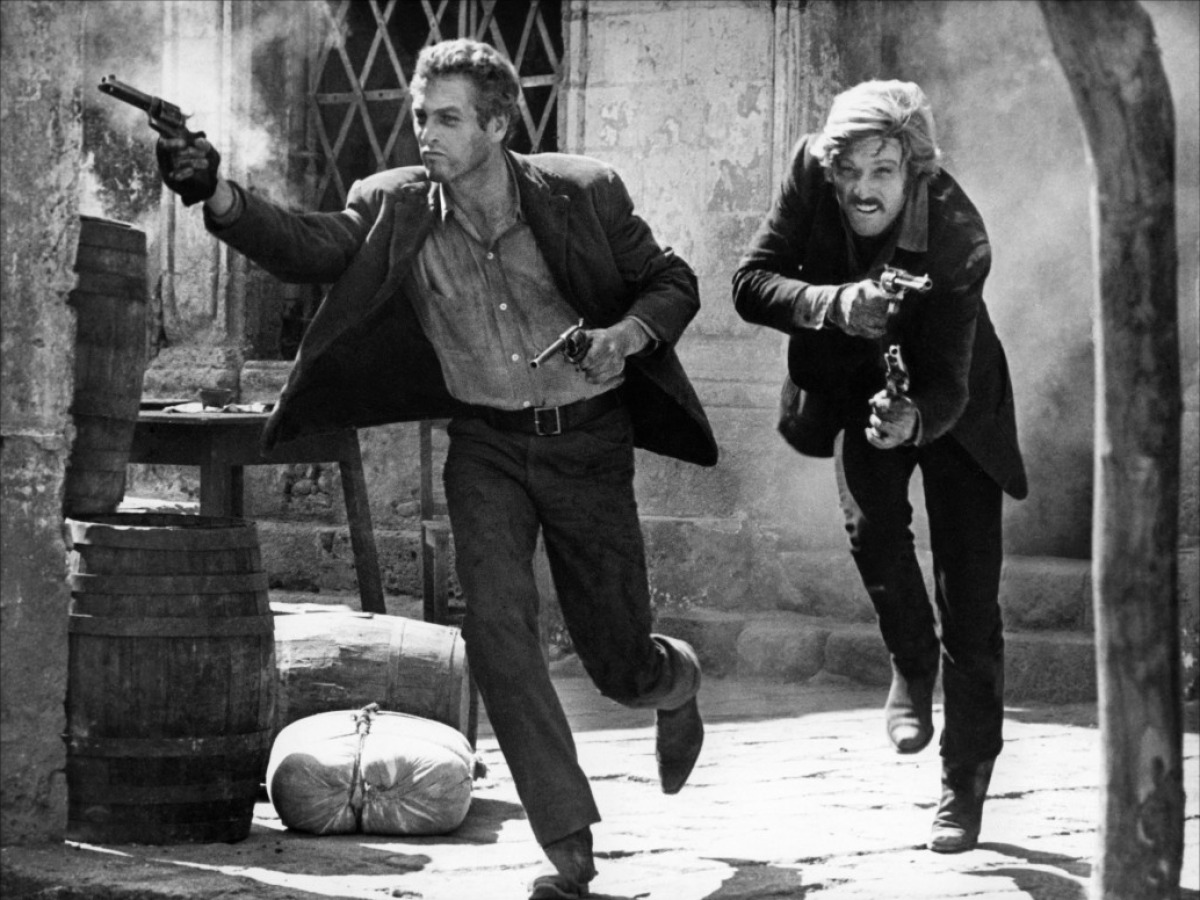
Butch Cassidy and the Sundance Kid

"You're still nothing but two-bit outlaws on the dodge. It's over, don't you get that? Your times is over and you're gonna die bloody, and all you can do is choose where."


"Wherever the hell Bolivia is, that's where we're off to."


When a filmmaker looks to the past, they can do so from an almost objective, if somewhat nostalgia-shaded viewpoint.  The period drama portrays traditions and styles of that time which are now almost completely lost, and sometimes a hint of modernity is allowed to peer through, connecting the contemporary audience to the old stories they watch.  This all makes for a nearly universal theme throughout films and stories set in the distant past - Everything, at some point, is carried away by the currents of time.  This will happen to all of us, but we can most easily see it when we watch a film about Egyptian pharaohs, samurai, or cowboys.

Butch Cassidy and the Sundance Kid starts with a short silent film describing the exploits of its protagonists.  Right from the start, it lets you know they're all dead now, something which should seem obvious, and might detach the audience from the film, if not for the pitch-perfect performances delivered by Paul Newman and Robert Redford in the titular roles.  When you watch these two banter, it brings the long-dead historical figures to life, and might even allow you to forget their inevitable fates until the film reminds us of those dark clouds on the horizon.

The first five minutes of BCatSK are filmed in sepia tones, almost as a way of "introducing" us to this historical period.  Once the more naturalistic color bleeds in, we are fully immersed in this world, along for the ride with these likable, entertaining characters.  And indeed, we allow ourselves to be entertained by them for what feels like a very short time before that theme of inevitability sets in.  Butch and Sundance rob a train, when suddenly a second train approaches on the tracks.  It opens up and a posse rides out.  From that moment on, our protagonists are on the run.  A good 20 minutes of screentime is dedicated to them desperately fleeing their seemingly unstoppable pursuers.  Multiple times, after seemingly losing their tail only to pick it back up again, Butch and Sundance ask "who are those guys?"  We do get an answer to that question, but that question is missing the point.  Cassidy said something much more relevant the moment he first saw the posse: "Whatever they're selling, I don't want it."  The real question is, what is that posse selling?  The answer is, the same as the comic relief bicycle salesman from earlier in the film: the future.  This posse doesn't cause the physical death of Butch or Sundance, but it is their downfall.


The bicycle is a handy little visual metaphor for this idea of the inevitable current of time.  A sheriff tries to rally up an old-fashioned posse to go after the outlaws, but is overshadowed by a man selling this handy new transportation method, repeatedly insisting that it represents the future.  Butch Cassidy, amused by this spectacle, buys one, enjoying the rewards of technological and societal progress.  But what he ignores is that, as an outlaw, he is not a part of that society, and it will eventually reject him.  Indeed, while the bicycle is replacing the horse, a new kind of posse is replacing the old-fashioned, easily avoidable one proposed by the sheriff: the owner of a corporation decides he's fed up with being robbed, and assembles a team of the best trackers and lawmen across state lines.  Butch and Sundance both seem perplexed by the idea that these lawmen might leave their respective states - they're used to a posse assembled in one night, comprised of novice militiamen from a single town.  Once they've narrowly avoided this super-posse and decided to leave the country with Sundance's girlfriend Etta Place, Butch Cassidy discards his new bicycle, realizing he wants no part of this new world.  The camera holds on the spinning wheel on the ground, and we return to sepia.  This wheel could represent either the unstoppable wheel of time, or Butch and Sundance's wheels spinning to a stop.  The good times are behind them now.  They're on the run, as much as they might tell themselves they're going to Bolivia by choice.

And of course, Bolivia is where they die.  The final act of this movie is a depiction of two once-great men getting swept aside by time, trying desperately to cling to their former ways.  Right near the end we see them at a complete 180 from the Butch and Sundance we've known: rather than two charming outlaws using their wits to avoid violence and escape tricky situations, we see two men gone straight, committing a brutal act of violence to get their money back.  Etta leaves them.  In their final scenes before the climactic shootout, their carefree rapport is all but gone.  They're two tired, stressed and disgruntled men who don't know what they want anymore.  Then the entire Bolivian army arrives and kills them.  In their final moments, they do retain some dignity, and find the spark of what used to drive them now that they have a motive, as desperate and hopeless as it may be.  They charge outside and, in an iconic moment, the camera freezes on them, in presumably the final moment we get to see them alive.  That sepia returns as we hear, but don't see, the hail of gunfire that cuts them down.  Time continues on without them, but we have been fortunate enough to see Butch Cassidy and the Sundance Kid frozen and preserved for our enjoyment.

               "I won't watch you die. I'll miss that scene if you don't mind."


Works Cited:

Butch Cassidy and the Sundance Kid. Dir. George Roy Hill. Perf. Paul Newman, Robert Redford, Katharine Ross. Twentieth Century-Fox Films, 1969.

Thursday, February 13, 2014

Juno

Over the past few years, an entire sub-genre of cinema has sprouted up, referred to as "indie films".  They are identified not by their independence from major distributors, but by their low-key drama, young and quirky protagonists, and soundtracks showcasing unknown acoustic artists, often the stars themselves.  At the genesis of this movement in 2007 was Juno.


It stars Ellen Page in her breakout role as the eponymous protagonist, a high schooler who was knocked up by boyfriend Paulie Bleeker (Michael Cera).  She decides to keep the child and give it to a pair of seemingly ideal adoptive parents (Jennifer Garner, Jason Bateman).  Meanwhile, quirky acoustic music plays in the background, and Juno and her friends employ a lot of bizarre slang that is already aging poorly, and fortunately never caught on.  Hence, Juno quickly gained its reputation as "that popular movie about teenage pregnancy with quirky humor", something that was viewed as kind of revolutionary at the time.

After seven years, Juno's freshness has faded and it can be judged on its own timeless merits and faults.  It is certainly not without fault.  The opening scene plays out clumsily, giving the film a shaky foundation - we see Juno standing on her lawn, observing a chair, with voiceover "It started with a chair".  Cut to flashback of Juno preparing to copulate with Bleeker, and unwittingly conceive a human life.  This established, she inexplicably adds, in voiceover, her admiration for the living room set.  Then the opening credits commence, set to the first of many mumblecore love songs.  These shaky first couple minutes give us an idea of what the rest of the entire film will be like - genuinely compelling human drama interspersed with awkward humor.  As the film gradually comes to emphasize the former, in typical dramedy fashion, it finds its legs.

The film's humor is not one hundred percent terrible, but notably it seems like the funniest moments are the halted deliveries in Page's exchanges with her parents, her child's prospective parents, and Bleeker.  Diablo Cody's script itself delivers few genuine laughs, and a lot of lines like "honest to blog".  And when the film dispenses with its cuteness, it has some fascinating character study to provide.  Juno, feeling adrift and alienated at high school, gravitates closer and closer to Mark, the adoptive father, who is creepily receptive.  What does Juno want out of this budding relationship?  What does Mark want?  Neither seems absolutely certain - the only definitive truth is that a tryst between the two is a terrible idea.

The film's action could accurately be classified as episodic, divided into three definitive acts with themes and tones linked to their respective seasons - "Fall" establishes our characters and their worries about the future, "Winter" brings conflicts to a head and pushes the characters to their low point, and "Spring", naturally, has a motif of birth/rebirth - Juno gives actual birth to the baby, Vanessa starts a new life as a single parent, Mark throws it all away and heads off to unknown midlife crises, Juno and Bleeker begin their relationship anew, doing so "backwards", as Juno describes it.  Of course, the action could also accurately be described as rising.  Though the +-nine months of the film's story are divided by seasons, the action itself is fairly straightforward, featuring the same characters and the same fundamental conflicts throughout, all driven by Juno's pregnancy.

2.5/4 stars


Works Cited

Juno. Dir. Jason Reitman. Prod. Lianne Halfon, John Malkovich, Russell Smith, and Mason Novick. By Diablo Cody. Perf. Ellen Page and Michael Cera. Fox Searchlight Pictures, 2007.

Barsam, Richard Meran., and Dave Monahan. Looking at Movies: An Introduction to Film. New York: W.W. Norton &, 2010. Print.

Saturday, January 25, 2014

Inside Llewyn Davis

Just FYI, this review contains spoilers.

"Wouldn't mind the hanging, but the laying in the grave so long;  Been all around this world, poor boy, been all around this world."


This is not a biopic.  Llewyn Davis is not a real person.  Real people like Llewyn Davis almost certainly existed, sure, but they're not the kind of people that get biographies of any kind.  Llewyn never gets his big break.  He doesn't spiral into drug-addled self destruction and find himself isolated at the top.  The implication, at the end of the film, is that this will never happen to Llewyn Davis.

And all that is okay, because this is a Coen Brothers film.  If we were talking Martin Scorsese, or Paul Thomas Anderson, you could reasonably expect a more sprawling epic, about a tortured artist reaching the pinnacle of worldly success and throwing it all away, then maybe dying or redeeming himself at the end, or whatever.  But the Coens have never really been about that.  Their films are small stories that find their sense of grandiosity in a wide existential backdrop.  On the surface of their stories, they are more attuned to farce, failure and anticlimax, and they have a real talent for finding the poetry therein.

The story of Llewyn Davis is one of many non-events.  He plays gigs at a small-time club for minimal profit, scavenges for royalty money from his agent, sings back-up vocals on a pile of shit called "Please Mr. Kennedy", and watches his career die before it ever even started.

Does this make someone like Llewyn Davis less significant than, say, Bob Dylan?  On a cultural level, sure.  But all the musicians of the 60s, both successes and failures, were human beings and artists.  Some of them made it big.  Most of them did not.  Compare this film to last year's "Not Fade Away", the feature debut of "Sopranos" creator David Chase.  Both films tackled these unsuccessful rock musicians.  But while "Not Fade Away" found its protagonist Douglas essentially outgrowing the music scene and going to film school, Llewyn Davis remains completely and thoroughly trapped when we part ways with him.  On one level, yet another brutal farce left him without any kind of job opportunity outside the music scene.  But on another level, we get the sense that music is all Llewyn Davis is really suited to, even if he will fail at it commercially.  After a closing number back at the Gaslight, his usual small-time venue, Llewyn announces "That's what I got."  And audiences are touched by his music, even if that doesn't mean success - as the camera pans in on producer Bud Grossman, listening to Llewyn's rendition of "The Death of Queen Jane", he sees something in the musician.  But nothing that will make him money, which, at the end of the day, is the ruling concern.

Llewyn Davis has nothing to his name but that music, but when he plays it we feel it.  He's the kind of character that other musicians would sing about, recalling the time when they were like him, with no big breaks on the horizon, and maybe recalling that without a stroke of luck, they might still be there.  Llewyn has no real expectations of success - after Bud Grossman's rejection his reaction is mostly resigned.  Llewyn's more concerned with where his next meal is coming from.

And though he has no mass audience in-universe to validate him, that doesn't really matter, because he has us, the people sitting in his movie theater, watching his story play out.  And it feels significant.  Llewyn's story gains a fable-like quality from the framing device of a cat belonging to one of Llewyn's hosts, the Gorfeins, as Llewyn accidentally lets it out, has to carry it around New York, loses it, finds it, realizes the new cat is a different one, and discovers later that the original cat found its way home on its own.  Even if he'll never find success, Llewyn still has a soul, and day-to-day things like that cat give his life meaning.  His partner, Mike, committed suicide before the events of the film - one can imagine that maybe he was too preoccupied with the big picture, lost sight of what it really means to exist in this world from moment to moment, and threw it all away.  But Llewyn keeps carrying that cat.

Midway through the film, everything comes to a halt as Llewyn hitches a ride to Chicago with two other musicians, burnout jazz player Rowland Turner and taciturn young beat poet Johnny Five.  We spend what feels like an eternity in the car with these two, though the journey amounts to about a day.  John Goodman is at his best in years playing Rowland Turner, a character who is equal parts absurdly comical and morbidly pitiful.  I lost track of how many times the film would cut from one shot in that car to another, hours later, interspersed with the almost hypnotic, trudging rhythm of the car passing over bumps in the highway.  This part of the film is where the Coens really indulged in what they do best, concocting a profoundly surreal sequence in which their character catches a glimpse of that existential backdrop looming over all his worldly affairs, and the story becomes almost mystical.  Llewyn goes on this surreal journey essentially alone, on a very different wavelength than either of his fellow journeymen.  And with what does this journey culminate?  Llewyn sitting in a club, playing a song for a music industry big-shot, and getting rejected.  That rejection, which felt almost inevitable, is really more of an afternote to the car ride with Rowland and Johnny.  As they say, it's more about the journey itself than the destination.  And in a film about someone like Llewyn Davis, that makes sense.


We all think we can see destinations in our future.  Some of us are musicians who keep playing gigs, hopping from band to band, waiting for the day when we make it big and become a household name.  Some of us are writers who keep making spec screenplays and reviewing movies on Blogspot, waiting for the day we make it big and become the showrunner for an award-winning drama series.  Some of us are careerists, looking towards the day when we meet the right partner, settle down, and start a family.  But ultimately, every perceived destination is an illusion.  That horizon stretches past your happy ending, and the only real conclusion in life is death.  The life of Llewyn Davis is this concept in its most distilled form.  Llewyn doesn't plan ahead, and doesn't count on any future goal to validate or satisfy him.  His whole life is one long journey.  At the end of the film, in which Llewyn is beaten up in an alley, just like he was at the beginning, with a budding Bob Dylan playing a song inside, we should be depressed by just how unfair Llewyn's life appears to be.  But he'll be alright.

Wednesday, January 22, 2014

The Matrix

The phobia addressed in The Matrix is an intangible one.  Until the truth of the Matrix is revealed, it doesn't seem like there's anything to fear.  You could live your whole life in ignorant bliss, to quote Cypher, grow old and die, seemingly in the real world, when in fact you are an overdeveloped fetus in a pod attached to a machine somewhere.  But if you take the red pill and wake up in that pod, you finally realize what's so terrifying about the Matrix: claustrophobia.  You are trapped inside this system.  You might not be able to see, hear or feel it, but you are trapped inside that pod.

This sense of claustrophobia is probably best captured in the film's most infamous sequence: Neo chooses the red pill, then touches a mirror, only to find its material growing on him, covering his body and travelling down his throat.  We cut from an interior shot of that throat to a p.o.v. of Neo's real-world predicament.  Everything about this sequence shows us Neo's ignorant perception butting up against the claustrophobia of his situation.  He is terrified of the reflective material coating his body uncontrollably, encasing and trapping him.  The camera travelling down Neo's throat traps us with him, and meanwhile indicates that there is a tube sticking down his throat in the real world.  The liquid mirror is a kind of symbol for Neo's body recognizing that it is surrounded by fluid.  Indeed, this sequence has some disturbing imagery, but is most terrifying for putting us in Neo's shoes as he discovers just how trapped and powerless he really is.

The Matrix explores the most viscerally terrifying aspects of its subject matter in another well-known scene: treacherous Judas figure Cypher decides that he will give Morpheus to the Agents, and kill off the crew of the Nebuchadnezzar, in exchange for being returned to the blissful ignorance of life in the Matrix.  With the crew split up inside the Matrix, Cypher exits, shoots the two conscious crew members, and proceeds to unplug the rest of them.  As Neo and the others gradually realize what's happening, the horror of this situation is best summed up by one crew member's last words: "not like this".  It's a chilling way to go, being aware of the fact that your life is in the hands of someone looming over your unconscious body.  The parallel editing between the crew in the Matrix standing around, and their helpless forms in real life, as Cypher first gets creepily intimate with Trinity, then toys with Neo in humiliating fashion, convey the same sense of impotence.  The only reason Neo and Trinity survive this is essentially a Deus Ex Machina, as one of the conscious crew members recovers from his injury and kills Cypher.  As powerful as Neo might become, even once he realizes he is the One, all it takes is one weak-willed team member back in reality, and he can essentially die of an aneurysm.


Outside of the sense of claustrophobia provided, the Wachowskis employ some more cryptic techniques to establish a sort of visual continuity throughout the film.  The aforementioned scene of Cypher looming over Trinity's unconscious form, lamenting his feelings for her, is paralleled in the climax of the film in less sinister fashion, when Neo has seemingly been killed, and Trinity leans over his body, confessing her love to him.  Soon afterward, when Neo has been established as The One and exercises his powers, he freezes a hail of bullets in the air and causes them to fall.  This cuts to a shot of a screen on the Nebuchadnezzar
, with the iconic "falling data" image paralleling the bullets.  Ultimately, almost all of the imagery and editing in The Matrix is about drawing that line between the Matrix world and real life.


Works Cited
The Matrix. Prod. Andy Wachowski and Lana Wachowski. Dir. Andy Wachowski and Lana Wachowski. By Andy Wachowski and Lana Wachowski. Perf. Keanu Reeves, Carrie Ann Moss, and Laurence Fishburne. Warner Bros., 1999.