To quote Mean Girls, this is the ruling dogma of a whole generation of horror movies throughout the 70s and 80s (At least the "die" part, unless we're talking about certain David Cronenberg films). It's a message almost inextricably associated with religious social conservatism, and that's how the trend has been viewed. Teenagers fool around and are punished for it by the wrath of God (or the wrath of an inbred man with a sharp farming tool and no chill). One can almost picture a crowd of old, stuffy white men packing the theater nodding in approval at each gory death scene. Yet that's not who the audience was. The audience was sex-having teenagers.

Since its release this month, and really since the release of its first trailer, aspiring cult horror film It Follows has been referred to by a number of titles - "The STD Horror Movie", "The Sexually Transmitted Demon movie", "A Movie That Symbolizes HIV, Herpes, and Other Sexually Transmitted Diseases By Embodying Them As A Scary Monster". Basically, audiences saw the premise and immediately latched onto the clearest A-to-B metaphor and thought they were some really smart motherfuckers. (When I say "audiences", I mean me)
 This brings me back to the apparent social conservatism of the teenage sex horror movie. Why would the audience for such a movie be teenage fornicators, the very people it was victimizing? Because that's the point of a horror movie. We put ourselves in the shoes of the protagonist, so that the movie can terrorize the protagonist and therefore terrorize us. What's more natural and human than a desire for sexual intimacy? And what could be scarier than attaching some kind of unspeakable, horrific punishment to such a natural human desire? Of course horror movies punish their characters. The whole point of a horror movie is to punish the audience for watching it. It Follows is effective because you can see the work director David Robert Mitchell has put into fully understanding the primal fears that will keep us on edge. Early on, in a scene just before we're shoved face-first into the spooky shit, protagonist Jay waxes philosophical about her sex life:
"I used to daydream about being old enough to go on dates. I had this image of myself holding hands with a really cute guy, driving along some pretty road. It's never about going anywhere, really. It's about having some sort of freedom, I guess."
Mitchell kills two birds with one stone here - first, he blocks the audience off from judging Jay. Even if you have something against consensual sex between young adults, it's hard not to empathize with a longing for freedom. Second, he pretty much spells out exactly which primal phobia he'll be needling us with for the rest of the movie: a fear of being trapped. Jay's longing for freedom is snuffed out when we learn the details of her curse. The Follower traps her in the worst way. Sure, on a physical level she's still free to travel the world. But as far as she drives, wherever she goes, as much distance as she puts between herself and her tormentor, it's still going to follow her. She's put in a psychological cage where, no matter what, she must always be on edge. Even after she transfers the curse to someone else she won't be completely free - it's made clear that when the Follower kills one victim, it will return to whoever it was following before that. For all intents and purposes, the curse is inescapable. That's where the real fear comes from, and where the use of metaphors becomes null. Sure, this type of menace can be compared to the after-effects of trauma. Yes, on a technical level it functions sort of like an STD. But this movie is not a symbolic one. Mitchell has carefully designed a monster with a set of rules that maximize fear the way no real-life threat quite does (except death itself, I guess).
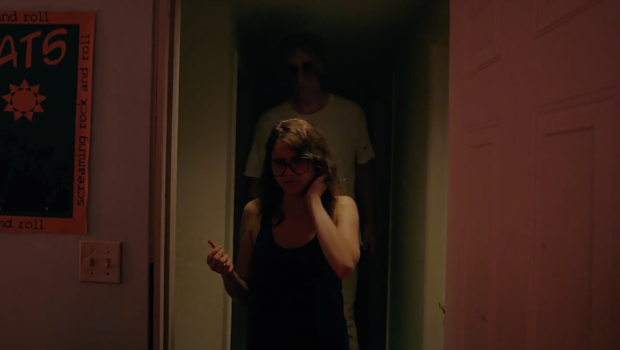 On the more tangible side of things, It Follows makes the most of all that contemporary filmmaking technology has to offer, resulting in a gripping and tense movie-going experience. The electronic soundtrack by Disasterpeace takes aesthetic cues from the 80s synth style, but the digital format allows for a sleeker, sexier and more layered sound - think Nicolas Winding Refn's Drive. The deep-focus on the vivid digital camera lets us see more clearly the figure coming towards us in the background who may or may not be Jay's Follower, and depicts a more beautiful and colorful world in which to set this horror story. The script provides a relentless pacing that really highlights the level of dread invoked by the curse. The psychosexual implications of the premise are not ignored, and certain forms taken by the Follower - especially at climactic moments, especially when it gets close - invoke a Freudian level of discomfort and repulsion. Mitchell is not the first horror filmmaker to come up with a scary, creative premise, but he's one of the proud few who really mine it on all levels to achieve its full potential.
